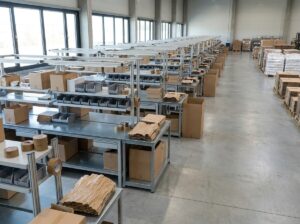

To automate a dropshipping business means using software to handle the repetitive, time consuming tasks that currently require your manual attention: forwarding orders to suppliers, syncing inventory levels, adjusting prices, updating tracking numbers, sending post-purchase emails, and responding to common customer questions. A properly automated dropshipping store saves 15 to 30 hours of manual work per week, according to multiple 2026 automation guides, and reduces operational costs by 40 to 60 percent compared to manual processes. That time goes back into marketing, product research, and store optimization, the activities that actually grow revenue.
But here’s the thing that every automation guide misses: software automation in dropshipping routes information. It doesn’t automate what happens inside your supplier’s warehouse. No tool automates what your supplier picks, how they pack it, whether quality is consistent batch to batch, or whether they’ll run out of stock mid-campaign. The most complete software stack you can build still leaves the physical fulfillment process variable and unpredictable. This guide covers the complete dropshipping automation stack, what each tool does, and then addresses the automation ceiling that no software can break through and what actually does.

What Is Automated Dropshipping — and What It Isn't
Automated dropshipping uses software integrations to handle predefined workflows without human intervention after initial setup. When a customer orders, the system automatically forwards those details to the supplier. When a supplier updates their stock, the system automatically adjusts your store’s listed quantity. When a price changes at the supplier level, the system automatically adjusts your retail price to maintain your target margin.
What Automation Genuinely Handles
The tasks that software automation handles reliably and completely are all information tasks: moving data from one system to another according to rules you set. Order details from your store to your supplier. Stock levels from your supplier to your product pages. Tracking numbers from your supplier to your customer. Price changes from supplier feeds to your listed retail prices. These are data flows with clear inputs and outputs, and they’re exactly what software excels at.
What Automation Cannot Handle
The tasks that software automation cannot handle are physical tasks: the actual picking of the product from a warehouse shelf, the quality of how it’s packed, the consistency of the packaging materials used, and the reliability of the carrier your supplier chooses for that specific order. A February 2025 St. Louis Fed analysis confirmed that automation tools save users an average of 5.4 percent of their work hours meaningful, but bounded. The work hours that software can’t save are the ones spent on customer service problems that originate from physical fulfillment failures that no software prevented.
The Five Pillars of Dropshipping Automation — Built in Order
The dropshipping automation stack has five distinct pillars. Build them in this order: automating a later pillar before an earlier one wastes time and money because the output of each pillar feeds the next.
Pillar 1 — Order Processing Automation
Order processing is the highest-leverage automation for any dropshipping store. Without it, every order requires you to manually log into your supplier’s platform, copy the customer’s shipping address, place the order, and record the tracking number. At five orders per day this is tedious. At 50 orders per day it’s a full time job. At 150 orders per day it’s impossible without a team.
DSers is the official AliExpress partner app and the most widely used order processing automation for AliExpress-based dropshipping. It places bulk orders to AliExpress suppliers in seconds rather than minutes per individual order, syncs order status back to Shopify or WooCommerce automatically, and is free for up to 3,000 products. Its limitation is AliExpress-only if you source from multiple platforms, you need a different tool.
AutoDS is the most comprehensive multi-supplier order automation platform in 2026. It handles order forwarding, tracking sync, price monitoring, and stock level alerts across multiple supplier sources simultaneously. It supports Shopify, WooCommerce, eBay, Wix, and Facebook Marketplace. Plans start at approximately $26 per month and scale with order volume. For stores sourcing from more than one supplier network, AutoDS removes the need for multiple single function tools.
Zendrop combines supplier sourcing with order automation and is particularly strong for stores wanting fast US shipping. Orders flow automatically from your Shopify store to Zendrop’s vetted supplier network, tracking is updated automatically, and branded packaging options are available from paid plans upward.
Pillar 2 — Inventory Sync Automation
Real-time inventory sync prevents the most expensive operational failure in dropshipping: overselling a product your supplier no longer has in stock. Without sync, you’re relying on periodic manual checks to catch supplier stock changes an approach that scales to roughly 10 products before it becomes unmanageable and unreliable.
StockSync is the go-to Shopify multi-channel inventory sync tool for stores managing stock across multiple sales channels your store, Amazon, eBay simultaneously. It updates stock levels automatically when a sale happens on any channel. Latency can run 10 to 15 minutes during high-velocity periods, which is why the safety buffer approach (listing 85 to 90 percent of reported supplier stock) is still necessary alongside any sync tool.
Inventory Source connects your store to its verified supplier network and syncs product data, stock levels, and order status automatically. It integrates with Shopify, Magento, and WooCommerce. The free tier allows supplier discovery but not product imports paid plans start at approximately $99 per month for full automation.
SparkShipping handles multi-supplier inventory at the enterprise level connecting via CSV, XML, API, EDI, or FTP depending on what each supplier provides. It applies intelligent order routing logic, sending each order to the supplier with available stock and the lowest cost at that moment. For stores managing ten or more supplier relationships, SparkShipping’s routing intelligence is more valuable than any manual routing decision could be.
Pillar 3 — Price and Margin Automation
Dynamic pricing automation adjusts your retail prices automatically when your supplier changes their wholesale price protecting your margin without requiring you to monitor every SKU manually. AutoDS includes price monitoring and dynamic repricing as part of its core feature set. When a supplier raises their price by 10 percent, AutoDS automatically raises your retail price by the same percentage or by your configured markup rule, preventing the margin erosion that catches manual sellers off-guard during supplier price fluctuations.
For stores with complex pricing rules different markup percentages by category, minimum price floors, maximum price ceilings dedicated repricing tools offer more granular control than all-in-one platforms. Prisync and Wiser are the established options in this category, though their primary strength is competitor price monitoring rather than supplier-cost-triggered repricing.
Pillar 4 — Email and Post-Purchase Automation
Email automation is the highest-ROI marketing automation available to dropshipping stores. Five automated email flows alone can meaningfully increase revenue without ongoing manual work: abandoned cart recovery (typically recovering 5 to 15 percent of abandoned carts), welcome series for new subscribers, post-purchase follow-up for review requests and upsell offers, cross-sell recommendations based on purchase history, and win-back campaigns for customers who haven’t ordered in 60 to 90 days.
Klaviyo is the industry standard email automation platform for Shopify dropshipping stores, powering over 176,000 brands worldwide. Its free plan supports up to 250 contacts. Paid plans scale from $20 per month. Klaviyo’s AI predicts customer behaviour, optimises send times, and personalises content the abandoned cart flow alone justifies the subscription for stores doing consistent daily orders. Klaviyo also launched its AI Customer Agent in 2025, which handles customer service inquiries automatically using your store’s order data.

Pillar 5 — Customer Service Automation
Customer service volume scales linearly with order volume in manual operations. With automation, it doesn’t have to. The most common customer service inquiries in dropshipping “where is my order?”, “what’s the status of my return?”, “what are your shipping times?” can be handled by AI-powered chatbots that pull real order data from your Shopify store without human involvement.
Gorgias centralises customer inquiries from email, live chat, and social media into a single dashboard and uses AI to automatically respond to common questions, route complex pre-sale inquiries to human agents, and close tickets without manual review. Starter plans begin at $10 per month. Tidio offers similar AI chatbot functionality with a stronger focus on conversion-oriented chat for visitors who haven’t yet purchased reducing the live chat overhead that high-traffic stores accumulate.
Building Your Automation Stack by Business Stage
The right automation stack depends on where you are in your dropshipping journey. Over- automating early wastes money. Under-automating at scale creates operational bottlenecks that cap your growth ceiling.
Stage 1 — 0 to 50 Monthly Orders: One Tool, One Problem
At this stage, manual processes are manageable everywhere except order forwarding. Start with one order processing tool DSers if you source from AliExpress, AutoDS if you source from multiple platforms. Don’t invest in email marketing automation or customer service tools yet. Your order volume is too low to generate enough data for meaningful email segmentation, and your customer service volume is too low to justify the tooling cost. Focus your time on product testing and ad creative.
Stage 2 — 50 to 500 Monthly Orders: Sync and Email
At this stage, manual inventory management begins failing. Suppliers stock out faster than you catch it. Add real-time inventory sync through StockSync or Inventory Source. Simultaneously, set up Klaviyo’s five core automated flows abandoned cart, welcome series, post-purchase, cross-sell, and win-back. These flows run in the background and generate revenue without ongoing attention. The combination of inventory sync and email automation adds meaningful revenue and prevents the stockout-driven customer complaints that plateau stores at this stage.
Stage 3 — 500+ Monthly Orders: Full Stack and Routing Intelligence
At 500 or more monthly orders, manual anything creates errors. Build the full stack: multi-supplier order routing via SparkShipping or Flxpoint, dynamic pricing automation via AutoDS, customer service automation via Gorgias, and email personalisation via Klaviyo’s AI behavioural flows. At this volume, every hour saved by automation compounds significantly. McKinsey’s 2025 analysis confirms automation can reduce operational costs by 40 to 60 percent at scale the difference between a store that operates profitably and one that generates revenue while spending it all on overhead.
The Automation Ceiling — What No Software Can Fix
Here’s the insight that none of the automation guides above will tell you. At some point, you’ve automated everything that software can automate. Orders forward instantly. Inventory syncs in real time. Prices adjust automatically. Emails send themselves. Customer questions get answered by AI. And yet: your supplier ships the wrong item. Your customer receives generic packaging with the supplier’s logo on the label. Your bestselling product goes out of stock at your supplier’s warehouse during your biggest campaign because another buyer cleared their stock before your sync caught up.
Every one of these failures originates in the physical fulfillment process the warehouse, the pick, the pack, the carrier handoff. And no software tool in the world can automate what happens in someone else’s warehouse. That’s the automation ceiling of supplier-direct dropshipping: you can make the information layer perfectly efficient, but the physical layer remains probabilistic because it’s not yours to control.
The ceiling breaks when the physical process becomes yours. Not by building your own warehouse by partnering with a 3PL that holds your inventory and fulfills from it.
How Fulfillmen Breaks the Dropshipping Automation Ceiling
Fulfillmen is the infrastructure layer that makes dropshipping automation complete by making the physical fulfillment process deterministic instead of probabilistic.
WMS Integration That Automates the Physical Process
Fulfillmen’s warehouse management system integrates directly with your Shopify store. When a customer places an order, the WMS receives it automatically and generates a pick instruction for the specific SKU from your inventory. A QC-checked unit of your own stock is picked, packed to your brand specifications, custom box, branded inserts, tissue paper and handed to the carrier. Tracking is generated and pushed back to Shopify automatically. Your customer receives an order notification with a real tracking number that scans from despatch to door.
Every step is automated. Every step is deterministic. There’s no supplier variability in what gets picked, no packaging inconsistency in how it’s packed, no tracking gap because the carrier is domestic. The automation tools you’ve already built, order forwarding, email flows, customer service AI all work better because they’re feeding a fulfillment process that doesn’t produce the errors they’d otherwise have to manage.
D2C Procurement — Automating the Sourcing Step
Before your inventory arrives at Fulfillmen’s warehouse, Fulfillmen’s D2C Procurement service handles the sourcing: finding Chinese manufacturers at 1688-level pricing, negotiating terms, managing factory QC, and coordinating shipping to Fulfillmen’s US warehouse network. You specify the product requirements. Fulfillmen handles the supply chain from Chinese factory to warehouse shelf. When your Shopify store runs low on a SKU, you initiate a replenishment request and the physical inventory process runs again, from factory to warehouse, without requiring your daily operational involvement.
90 Days Free Storage — Automation Without Carrying Cost
Fulfillmen’s 90-day free storage model removes the storage cost line that typically makes owned inventory more expensive than supplier-direct fulfillment at low volumes. You import inventory by sea freight at the lowest per-unit transport cost. It sits in Fulfillmen’s US warehouse at zero storage cost for 90 days. Customer orders ship domestically at 2 to 5 day speeds. The automation runs. The storage is free. The customer experience is consistent. [Contact Fulfillmen today] to see how the stack maps against your current order volume and tool setup.

The Automation Mistake That Kills Margin
There’s one common automation error that the guides don’t flag: automating a broken process makes the breakage faster and more expensive. If your supplier ships inconsistent quality and you automate order forwarding to them at 200 orders per day, you’ve automated 200 quality problems per day. If your supplier goes out of stock mid-campaign and your inventory sync has a 15-minute lag, you’ve oversold 15 minutes of orders automatically. Software doesn’t evaluate whether the underlying process is sound it executes what it’s configured to execute.
The right sequence is: fix the physical process first, then automate the information layer on top of it. Validate your supplier’s quality with sample orders. Confirm your inventory sync captures their real stock accurately. Set realistic delivery windows in your product listings. Then build the automation stack on a foundation that produces consistent outputs because automation amplifies whatever process it touches, good or broken.