
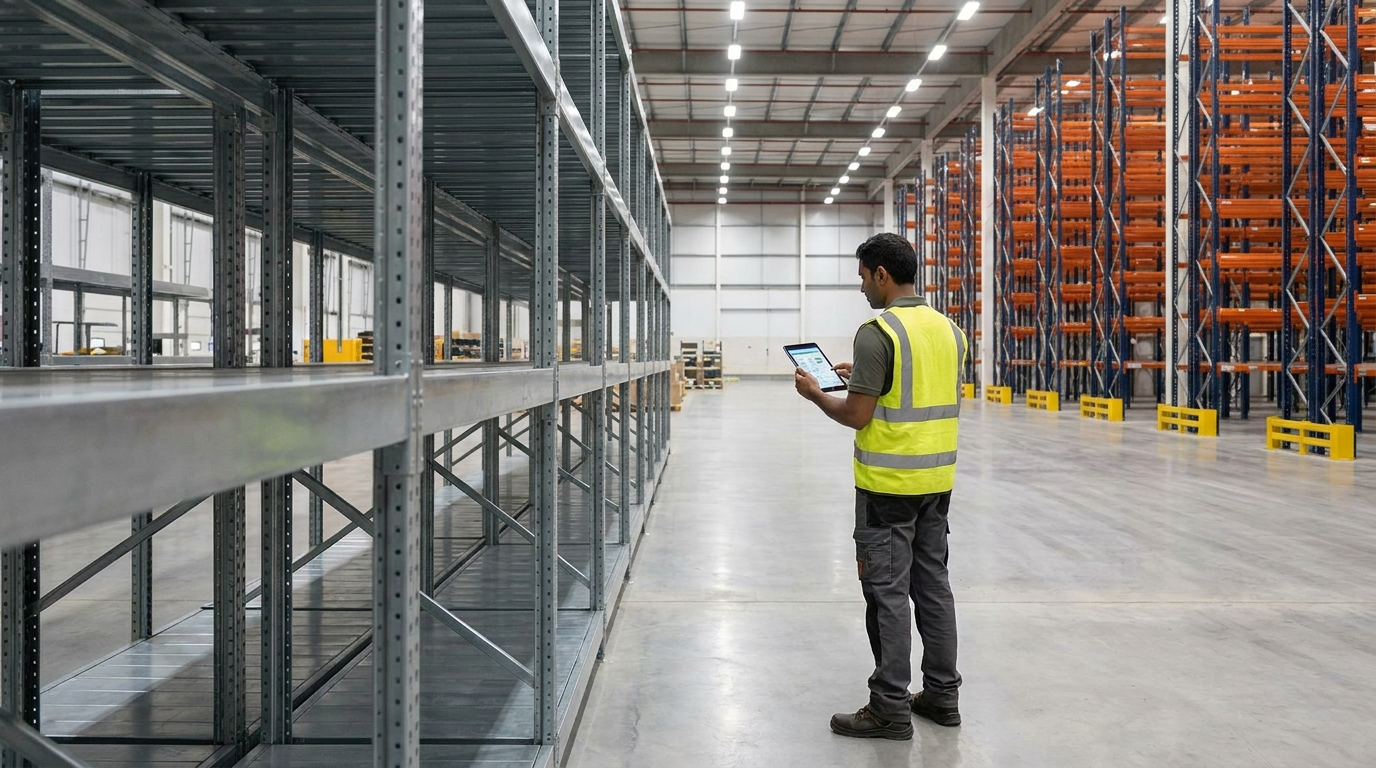
A stockout is what happens when available inventory reaches zero while customers still want to buy. The order cannot be fulfilled, the product page goes dark, and the customer goes elsewhere often for good.
That single event costs more than the immediate lost sale. According to a 2023 IHL Group study, inventory distortion, of which out-of-stocks are the largest part, was set to cost global retailers $1.77 trillion that year. For ecommerce brands, the number is compounded by a second hit: marketplace algorithms penalise inconsistent availability, suppressing your ranking for weeks or months after you restock, long after the shelf is full again.
This guide covers what a stockout is, what causes it, how to calculate the real cost (including the 2026 tariff multiplier on emergency restocking from China), and the three-part prevention stack that removes stockout risk without tying up unnecessary capital in inventory.

What Is a Stockout? Definition
A stockout occurs when inventory for a specific product is completely exhausted at the moment a customer attempts to buy it. The order cannot be fulfilled from existing stock. In ecommerce, the result is an out of stock listing, a paused ad campaign, a cancelled order, or at its worst a lost customer who found your competitor within thirty seconds.
Stockout is also called an out of stock (OOS) event. The terms are interchangeable; this post uses stockout throughout.
Stockout vs Backorder vs Overstock
These three inventory states are often confused. The distinction matters because each requires a different operational response:
Term | What It Means | Customer Impact |
Stockout | Inventory is exhausted; no shipment covers immediate demand | Cannot purchase; order cancelled or lost |
Backorder | Inventory is exhausted but can be ordered and fulfilled on restock | Can place order; delayed fulfilment |
Overstock | Excess inventory on hand; capital tied up, storage costs rising | No immediate customer impact; internal margin hit |
A stockout without a backorder option means the customer has nowhere to go but a competitor. A backorder gives them a reason to wait but only if your lead time is credible and your communication is proactive.
What Causes a Stockout?
Most stockouts are not caused by a single failure. They are the downstream result of several compounding gaps in planning, execution, or supply chain coordination. The most common causes in ecommerce operations are:
Inaccurate demand forecasting
When sales velocity projections are based on outdated averages or don’t account for seasonality, marketing campaigns, or viral product moments reorder decisions lag reality. By the time the demand spike is visible in your data, you are already selling through your last units.
Long or variable supplier lead times
For brands sourcing from China, lead times of 15 to 45 days are standard for sea freight, and even express air freight runs 3 to 7 days. If you place a reorder based on a 20-day lead time and your supplier runs 28, you will stock out before the shipment lands. Lead time variability, not just average lead time is the hidden variable most brands underweight.
Insufficient safety stock
Safety stock is the buffer inventory held above your minimum operating level to absorb demand spikes and supply delays. Brands that run lean intentionally to reduce holding costs often hold safety stock levels that are too low to survive a single disruption. For a deeper look at how to calculate the right buffer, see our guide to safety stock.
Inaccurate inventory records
If your warehouse management system does not reflect physical stock accurately due to unlogged returns, damaged units not written off, or sync delays between sales channels your system may accept orders for products that no longer exist in your warehouse. The customer receives a cancellation notice after checkout. The damage to trust is disproportionate to the root cause.
Supply chain disruptions
Port congestion, carrier delays, supplier production stoppages, and customs holds are external events that compress your available buffer without warning. Brands with a single supplier and a single shipping route are most exposed. Any disruption anywhere in that chain triggers a stockout if safety stock is insufficient to bridge the gap.
Cash flow constraints
Reordering requires working capital. Brands with thin margins or slow paying wholesale channels sometimes cannot place reorders at the right time, even when they can see a stockout coming. The inventory problem is a finance problem in disguise.
What Does a Stockout Actually Cost?
The direct cost is visible: every unit you could not sell is lost revenue. But the full cost of a stockout is significantly higher than the immediate margin on lost sales.
The direct revenue formula
Direct Revenue Impact = Units Lost × Average Order Value × Gross Margin
Example: If you sell 15 units per day at a £60 average order value with a 40% gross margin, a 7-day stockout costs: 15 × 7 × £60 × 0.40 = £2,520 in direct margin loss.
The hidden multipliers
That £2,520 understates the true cost because it ignores three compounding factors:
- Marketplace ranking penalties: Amazon, Walmart, and Shopify algorithms reward consistent availability. A stockout event suppresses your product’s visibility in search and recommendation surfaces, and ranking recovery after restock can take weeks. The revenue loss continues well after your shelves are full.
- Emergency restocking costs: Replacing stock urgently means air freight instead of sea freight, and in 2026, post-tariff emergency restocking from China carries the full import duty burden plus expedited shipping premiums. What previously cost £8 per kg by sea may cost £40 per kg by air under time pressure, plus applicable tariff rates.
- Customer lifetime value erosion: Studies on ecommerce buyer behaviour consistently show that a meaningful portion of customers who encounter an out-of-stock message do not return. The stockout cost is not just the lost sale; it is the lost future revenue from that customer relationship.
A single stockout event typically costs 1.5× to 3× the direct lost margin once these factors are included. For high-velocity SKUs on marketplace channels, the combined impact of ranking loss and emergency restocking can push the true cost significantly higher. The practical takeaway: the carrying cost of additional safety stock (typically £2–£5 per unit per month) is almost always lower than the cost of the stockout it prevents.
What Is an Acceptable Stockout Rate?
A stockout rate of zero is theoretically possible but economically irrational the safety stock required to eliminate all stockouts for every SKU would exceed the revenue protected. The practical target varies by SKU classification:
SKU Class | Description | Target Service Level | Acceptable Stockout Rate |
Class A | Top 10–20% of SKUs by revenue | 98–99% | 1–2% |
Class B | Mid-range SKUs, moderate velocity | 95% | 5% |
Class C | Slow-moving, low-revenue SKUs | 90% | 10% |
For Class A SKUs your bestsellers and revenue-critical products a stockout rate above 2% is a signal that your reorder points, safety stock levels, or supplier lead time buffers need recalibration.
How to Prevent Stockouts: The Three-Part Stack
Effective stockout prevention is not one tactic, it is a system. The three components below, working together, eliminate the majority of preventable stockout events.
1. Demand forecasting that accounts for variability
Static reorder points based on average daily sales underperform because averages smooth out the peaks that cause stockouts. Use a rolling 90 day sales average as your baseline, then adjust for known variables: seasonal demand patterns, planned promotions, product launches, and the viral spikes that are impossible to predict but possible to buffer for.
For multi-channel operations, forecast at the channel level a product that sells 10 units per day on your DTC store and 5 units per day on Amazon is not a 15 unit per day product if the inventory pool is shared. Allocation decisions determine which channel stockouts first.
2. Data-driven safety stock with lead time variability built in
Safety stock calculated on average lead time only fails the moment a supplier runs late. The correct formula accounts for both demand variability and supply variability:
Safety Stock = Z × √(Lead Time) × Demand Standard Deviation
Where Z is your service level factor (1.65 for 95% service level; 2.05 for 98%). This formula keeps your safety stock calibrated to actual uncertainty rather than optimistic averages. For brands sourcing from China, where port delays and production pauses can extend lead times by 7 to 14 days without notice, this buffer is not optional; it is the difference between a managed delay and a stockout.
Note: carrying too much safety stock creates the opposite problem dead stock that ties up capital and warehouse space. Calibrate to your service level target by SKU class, not uniformly across your range.
3. Real-time inventory visibility across all channels
Stockouts caused by inaccurate records are entirely preventable. A warehouse management system that updates stock levels in real time across all sales channels simultaneously eliminates the gap between physical inventory and system inventory that causes overselling and phantom availability.
Fulfillmen’s warehouse inventory management infrastructure gives brands live stock visibility across all warehousing locations, with automatic sync to connected stores. When a unit ships, stock is decremented instantly not on the next daily batch update. This is particularly important for brands selling across multiple channels simultaneously, where inventory timing gaps can create stockouts on one channel before the other has absorbed existing demand.
How Fulfillmen Helps You Prevent Stockouts

Stockouts that originate in the supply chain, the majority for ecommerce brands sourcing from China, are infrastructure problems, not planning problems alone. A third-party logistics provider with warehouses positioned at the origin of your supply chain changes the equation.
Fulfillmen operates fulfillment infrastructure in Shenzhen, Hong Kong, and India at the point where most ecommerce inventory originates. This means:
- Stock can be held close to the source and dispatched on demand, reducing effective lead times and the safety stock buffer required to bridge them.
- Real-time WMS inventory tracking across all Fulfillmen warehouse locations gives brands accurate stock data at all times, not reconciled-at-midnight batch updates.
- Stock levels by SKU are visible in your Fulfillmen dashboard, so you can plan replenishment before reorder points are breached.
- No minimum storage requirements mean brands can hold appropriate buffer stock without being penalised for it; the carrying cost of prevention is accessible to operations of every size.
For brands currently packing orders themselves or managing inventory through an underperforming 3PL, the move to a connected fulfillment infrastructure is the single highest-impact step available. Learn more about ecommerce fulfillment services or explore why brands choose Fulfillmen as their global fulfillment partner.
Ready to remove stockout risk from your supply chain? Get a free quote from Fulfillmen and see what your replenishment cycle looks like with real-time inventory infrastructure behind it.
Frequently Asked Questions About Stockouts
What is a stockout in simple terms?
A stockout is when a product runs out of inventory and cannot be sold to customers who want it. The item shows as out of stock, orders cannot be fulfilled, and the brand loses both the immediate sale and potentially the customer’s future business.
What is the difference between a stockout and a backorder?
A stockout means inventory is gone and no fulfilment timeline exists. A backorder means inventory is gone but the customer can place an order and receive it when stock is replenished. Backorders preserve the sale; stockouts lose it.
How do you calculate stockout cost?
The basic formula is: Direct Revenue Impact = Units Lost × Average Order Value × Gross Margin. For a complete picture, add marketplace ranking recovery costs, emergency restocking costs (including air freight premiums and applicable tariffs), and an estimate of customer lifetime value lost to churn. The true cost is typically 1.5× to 3× the direct margin loss.
What is an acceptable stockout rate?
For Class A SKUs (your bestsellers), target a stockout rate of 1–2%, equivalent to a 98–99% service level. For mid-range Class B items, 5% is generally acceptable. For slow-moving Class C items, 10% is a reasonable operational threshold. A 0% stockout rate requires carrying excess safety stock that typically costs more than the stockouts it prevents.
How do you prevent stockouts?
The three-part prevention stack is: (1) accurate demand forecasting using rolling averages adjusted for seasonality and promotions; (2) safety stock calculated using the statistical formula that accounts for both demand variability and lead time variability; and (3) real-time inventory visibility across all sales channels to eliminate the record inaccuracies that cause phantom stockouts.
What causes stockouts more than anything else?
For ecommerce brands sourcing from overseas suppliers, the most common root cause is underestimating lead time variability, planning inventory on average lead times and then running out when a supplier or carrier runs late. The fix is safety stock buffers that account for worst-case lead time, not average lead time.