

Landed cost from China is the total cost of getting one unit from the factory to your warehouse, ready to sell: the product price plus freight, insurance, duties and tariffs, customs fees, brokerage and the final delivery. For US imports in October 2026, the duty part alone can add 40% or more to the factory price of many consumer goods, so a supplier quote is rarely more than two thirds of what each unit really costs you.
Below are the cost lines, the formula, a worked example and the decisions that move the number most. If you want the freight and customs part handled for you, see our logistics services.
Fulfillmen ships goods from China and quotes duty-paid freight, so we sell part of what this guide describes. Tariff rates come from Zonos and USTariffCalc summaries of US policy, checked on 18 October 2026. Customs fees are CBP’s figures for the year from 1 October 2026. Freight rates in the examples are assumptions, so use your own quotes.

What is included in landed cost
- Product cost: the unit price on your purchase order, usually quoted FOB (the supplier delivers to the port in China).
- International freight: sea, air or express from China to your country, including origin and destination handling charges.
- Insurance: cargo cover, often a small percentage of the goods value.
- Duties and tariffs: the normal (MFN) duty for your product’s HTS code, plus any extra China tariffs.
- Customs fees: in the US, the Merchandise Processing Fee (MPF) and, for sea freight, the Harbor Maintenance Fee (HMF).
- Brokerage and filing: customs broker fees and, for sea freight, the Importer Security Filing.
- Delivery to your warehouse: trucking from the port or airport to your 3PL, Amazon or your own site.
Storage, pick and pack and the cost of shipping to your customer come after landing. They belong in your cost per order, which our guide to China fulfillment cost covers separately.
The US tariff stack on China-made goods in 2026
US duty on Chinese products is now built from several layers, and the Supreme Court’s February 2026 ruling against the IEEPA tariffs removed only some of them.
Duty layers on goods made in China, US imports, October 2026
| Layer | Rate | Applies to |
|---|---|---|
| MFN duty | 0% to over 30%, set by HTS code | All imports |
| Section 301 China lists | 7.5% to 100%, set by HTS code | Most Chinese goods |
| New Section 301 duty from 24 July 2026 | 12.5% for China, added on top | Most goods, with listed exemptions |
| Section 232 | 25% to 50% | Steel, aluminium, copper, autos and parts, some timber |
| IEEPA fentanyl and reciprocal tariffs | Ended | Voided by the Supreme Court in February 2026 |
Sources: Zonos US tariff updates (14 October 2026) and USTariffCalc. Goods covered by Section 232 do not also pay the new 12.5% duty. Rates change often, so confirm yours by HTS code before you order. Our guide to import tax from China to the USA explains how to look up your code.
How to calculate landed cost per unit
Landed cost per unit = (goods + freight + insurance + duties + customs fees + brokerage + delivery) ÷ units
In the US, duty is charged on the transaction value of the goods, which normally excludes international freight. The UK and EU charge duty on the value including freight and insurance.
That last point catches many sellers out. A US calculation applies duty to the factory price only, while a UK or EU calculation applies it to the factory price plus shipping, then adds import VAT on top of everything.
Worked example: 1,000 kitchenware sets by sea to the US
This example uses a plastic kitchenware set bought at $4.00 FOB Shenzhen. In our example the product carries 3.4% MFN duty, 25% under Section 301 and the 12.5% Section 301 duty added in July 2026. Check the real rates for your own code.
Illustrative landed cost, 1,000 units by LCL sea freight. Freight, brokerage and delivery are assumed
| Line | How it is worked out | Cost |
|---|---|---|
| Goods | 1,000 × $4.00 | $4,000.00 |
| LCL sea freight and handling (assumed) | 2.5 CBM plus origin and destination charges | $550.00 |
| Insurance (assumed) | Flat cover | $15.00 |
| MFN duty | 3.4% × $4,000 | $136.00 |
| Section 301 China list duty | 25% × $4,000 | $1,000.00 |
| Section 301 duty from July 2026 | 12.5% × $4,000 | $500.00 |
| Merchandise Processing Fee | 0.3464% × $4,000 = $13.86, so the $34.58 minimum applies | $34.58 |
| Harbor Maintenance Fee | 0.125% × $4,000 | $5.00 |
| Customs broker and ISF (assumed) | Per entry | $175.00 |
| Port to warehouse delivery (assumed) | Truck | $250.00 |
| Total landed cost | $6,665.58 | |
| Landed cost per unit | $6,665.58 ÷ 1,000 | $6.67 |
Check: 136 + 1,000 + 500 = 1,636 in duty, which is 40.9% of the goods value. 4,000 + 550 + 15 + 1,636 + 34.58 + 5 + 175 + 250 = 6,665.58. The $4.00 product lands at $6.67, or 1.67 times the factory price. MPF and HMF figures are CBP’s rates for the year starting 1 October 2026.
Want this worked out for your own products? Send us the HTS code, unit price, quantity and carton sizes and we will build a landed cost for sea and air.
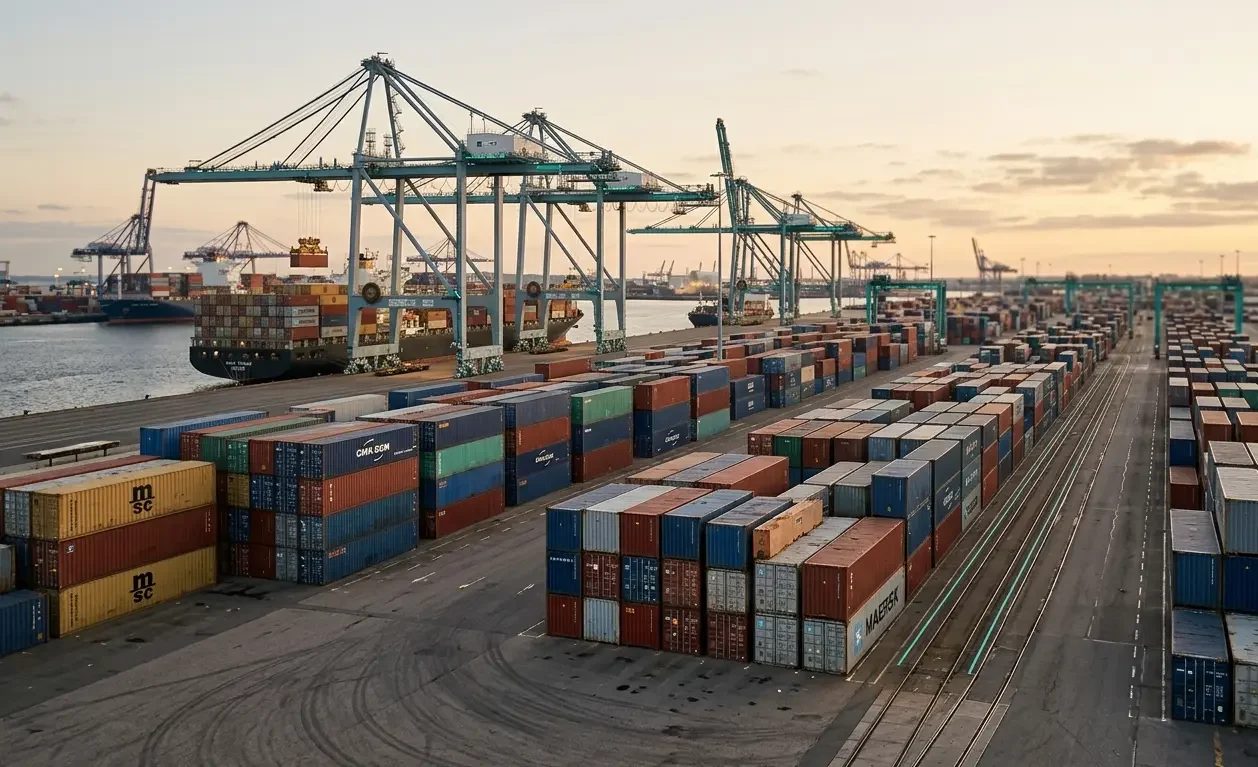
How landed cost changes between sea and air freight
Changing the freight mode changes more than the freight line. Air freight is priced on chargeable weight, and the Harbor Maintenance Fee does not apply to air shipments.
The same 1,000 units by air instead of sea. Air rate assumed at $6 per kg on 250 kg chargeable weight
| Line | Sea (LCL) | Air |
|---|---|---|
| Freight and handling | $550.00 | $1,750.00 |
| Harbor Maintenance Fee | $5.00 | $0.00 |
| All other lines | $6,110.58 | $6,110.58 |
| Total landed cost | $6,665.58 | $7,860.58 |
| Per unit | $6.67 | $7.86 |
| Typical door to door time | About 25 to 40 days | About 7 to 12 days |
Check: 6,665.58 − 550 − 5 = 6,110.58, and 6,110.58 + 1,750 = 7,860.58. Air adds $1.19 per unit here but gets stock selling about three to four weeks sooner. See our shipping from China to US cost guide for current rate ranges.
DDP and DDU: does the landed cost change?
The duty owed is the same either way. What changes is who pays it, when, and how predictable the total is. Under DDP (delivered duty paid) your forwarder quotes freight, duty and clearance as one price and pays customs for you, so the landed cost is known before the goods leave China. Under DDU or DAP you pay duty and fees on arrival, which keeps the freight quote lower but leaves room for surprises. For customer orders shipped straight from a China warehouse, DDP also means your buyer never pays at the door. Our guide to DDP shipping from China to the US explains who handles what.
Using landed cost to set your retail price
Retail price = landed cost per unit ÷ (1 − target gross margin)
Use landed cost, not the factory price. At a 60% gross margin, the $6.67 kitchenware set needs a price of at least $16.67 before fulfillment and marketing costs.
Running the numbers both ways shows why the factory price misleads. At $4.00 the same margin target suggests a $10.00 price. That gap of $6.67 per unit is the difference between a profitable product and one that loses money on every sale.

Landed cost mistakes that shrink your margin
- Budgeting from the supplier quote and adding freight only.
- Using last year’s duty rate. The tariff stack changed twice in 2026.
- Guessing the HTS code. The wrong code can mean a different Section 301 list and a penalty.
- Forgetting the MPF minimum, which matters on small shipments. Combining several suppliers into one entry helps, as our guide to consolidating shipments from China shows.
- Applying the US duty method to UK or EU imports, where freight is in the duty base and VAT is added.
- Dividing by the units ordered instead of the units you can sell after defects.
Do this next
List your top five products with their HTS codes, unit prices and carton sizes, then fill in the table above for each one. If you would rather have the freight and duty lines quoted for you, send us the list and we will price sea, air and DDP options.
Get a Duty-Paid Quote →Frequently asked questions
What is included in landed cost?
Landed cost includes the product price, international freight, insurance, duties and tariffs, customs fees such as the MPF and HMF, brokerage, and delivery from the port to your warehouse. Fulfillment and last-mile shipping to customers come after landing.
How do I calculate landed cost per unit?
Add every cost of getting the shipment to your warehouse and divide by the number of units. In the US, duty is charged on the goods value without international freight, so calculate duty first, then add it to the other lines.
Do tariffs count in landed cost?
Yes. For goods made in China, US tariffs usually include MFN duty, Section 301 duties and, from 24 July 2026, an extra 12.5% Section 301 duty for most products. Together they can exceed 40% of the goods value.
Is landed cost different for DDP and DDU?
The duty owed is the same. DDP bundles freight, duty and clearance into one price paid upfront, so the total is known in advance. DDU leaves duty and fees to be paid on arrival.
How does landed cost change between sea and air freight?
Air freight costs more per kilogram and is charged on chargeable weight, but it avoids the Harbor Maintenance Fee and gets stock selling weeks sooner. In our example, air added $1.19 per unit to a $6.67 sea landed cost.