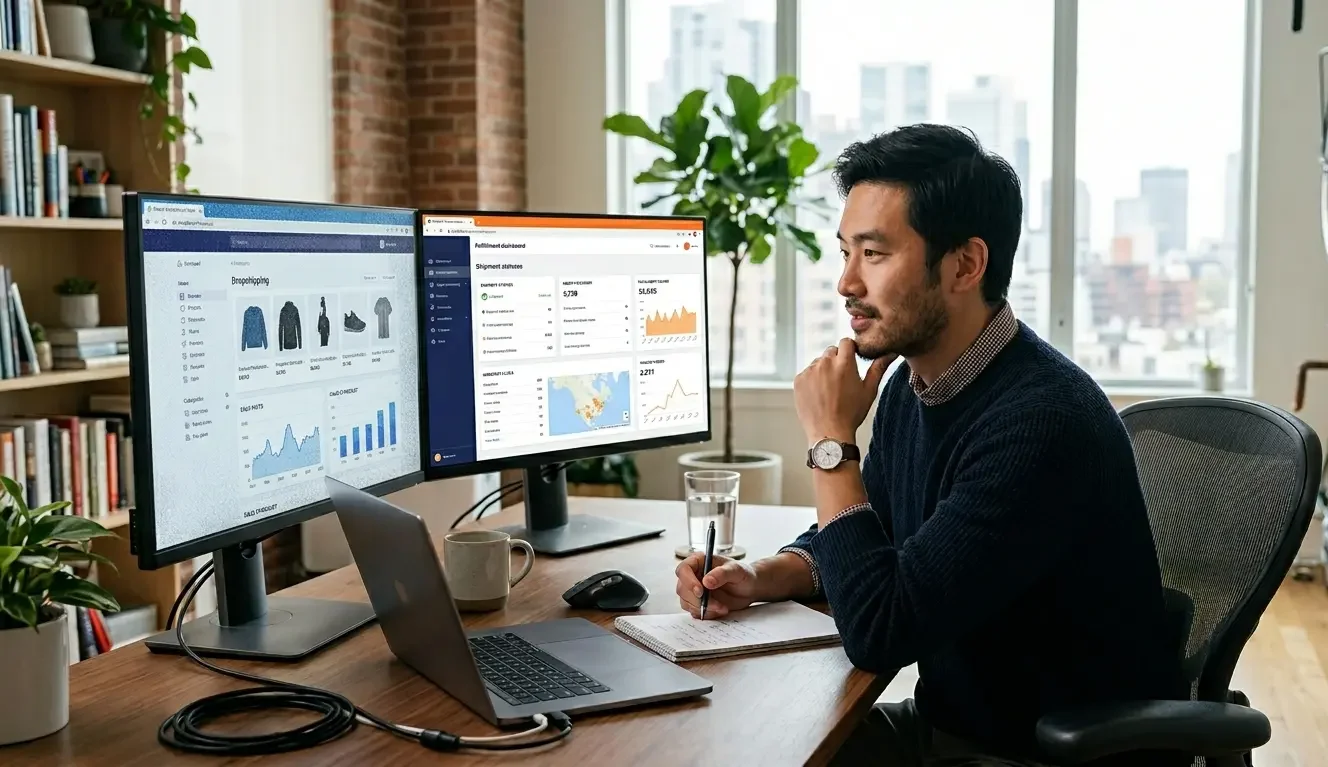
Dropshipping and 3PL are not interchangeable choices; they are two entirely different business models with different economics, different risk profiles, and different ceilings. Dropshipping lets you sell products without holding inventory: your supplier ships directly to your customer, you keep the margin, and you never touch a box. A 3PL fulfillment model means you own the inventory, store it with a third-party logistics provider, and they handle picking, packing, and shipping as orders arrive. The choice between dropshipping vs 3PL determines your profit margins, your shipping times, your brand control, and ultimately how big your ecommerce business can grow.
Fulfillmen offers both models: a dropshipping fulfillment service for testing products and full 3PL fulfillment once demand is proven.
Here is the honest answer most guides avoid: dropshipping is the right model when you are testing products and have not yet validated demand. A 3PL is the right model when you have validated products and want to grow them into a real brand with real margins. The problem is that most sellers stay in dropshipping too long, and the data makes the cost of that delay concrete: Shopify’s 2023 ecommerce report found average dropshipping profit margins of 18%, while brands using 3PL or in-house fulfillment averaged 41%. That 23-percentage-point gap is the real cost of the dropshipping vs 3PL decision and this guide gives you the exact signals that tell you when to make the switch.
What Is Dropshipping and How Does It Work?
How Dropshipping Works and Who It Is For
Dropshipping is a retail fulfillment model where you list products in your store, take customer orders, and forward those orders to a supplier who ships directly to your customer. You never purchase inventory before it sells, you never hold stock, and you never pack a box. According to Shopify’s dropshipping guide, around 27% of online retailers have adopted this model primarily because the barrier to entry is low, the capital risk is minimal, and you can test dozens of products without committing to bulk purchases. The mechanics are straightforward: customer orders on your Shopify or WooCommerce store, you pay the supplier’s wholesale price, the supplier ships to the customer, and you keep the difference between your retail price and the wholesale cost as your margin.
Dropshipping is the right model in two specific scenarios. First: you are in the product testing phase, launching into a new category, or evaluating demand for a concept before committing capital to inventory. Second: you are operating at very low volume under 200 orders per month on any single product where the economics of bulk purchasing and 3PL storage fees don’t yet justify the upfront investment. Outside of these two scenarios, the dropshipping vs 3PL comparison consistently favours 3PL for any brand serious about building a sustainable, scalable business with real margins.
The Real Limitations of Dropshipping at Scale
Dropshipping has a ceiling and most sellers hit it faster than they expect. The limitations are not hypothetical: they are structural features of the model that become more damaging as order volume increases. Shipping times from Chinese suppliers average 14 to 30 days for standard ePacket-style services, in a market where customers increasingly expect 5 to 10 day delivery. Quality control is non-existent; you have no visibility into how a supplier packs an order, what condition goods leave in, or how accurately they fulfil your specifications. Every supplier has multiple clients, and your orders compete for their attention. And because dozens of other sellers are listing the same products from the same suppliers, the only competitive lever available is price which erodes margins to the point where customer acquisition costs make the business unviable.

What Is a 3PL and How Does Fulfillment Work?
How 3PL Fulfillment Works
A 3PL, or third-party logistics provider, stores your inventory in their warehouse and handles picking, packing, and shipping orders as they arrive from your store. You purchase inventory in bulk from your manufacturer, ship it to the 3PL’s warehouse, and from that point forward the 3PL manages every operational step of fulfillment while you focus on marketing, product development, and customer relationships. According to Red Stag’s 3PL definition guide, the 3PL model includes warehousing, order management, carrier rate negotiation, and returns processing as an integrated service meaning you pay for a complete logistics operation rather than building one yourself. Orders placed in your Shopify or WooCommerce store sync automatically to the 3PL’s warehouse management system, and tracking numbers push back to your store in real time.
The 3PL model inverts the dropshipping risk profile. Instead of zero upfront capital and thin margins per order, you commit capital to inventory upfront and earn significantly better margins because you’ve negotiated bulk pricing with your manufacturer and eliminated the per-unit supplier markup. You also gain control over packaging, product quality, delivery times, and the customer experience all things that dropshipping removes from your hands entirely. The trade off is real: you are taking inventory risk. But inventory risk is manageable when you have product validation data behind you, and it is the price of admission for building a brand that can compete on quality and delivery rather than only on price.
The Margin Reality: Dropshipping vs 3PL Side by Side
The clearest way to understand the dropshipping vs 3PL decision is through the margin data. Shopify’s 2023 ecommerce report found that average dropshipping profit margins sit at approximately 18%, while brands managing their own inventory through a 3PL or in-house fulfillment averaged 41% profit margins. That 23-percentage-point gap compounds dramatically at scale. A brand doing $50,000 per month in revenue earns $9,000 in profit at a dropshipping margin versus $20,500 at a 3PL margin, a difference of $11,500 per month, or $138,000 per year. The global 3PL market reached $1.6 trillion in 2024 and is growing at 8.5% CAGR through 2030 according to Grand View Research driven primarily by ecommerce brands making exactly this transition from supplier-direct fulfillment to managed logistics operations.
When Dropshipping Breaks Down: The 5 Signals
The Quality Control Problem
The first signal that your business has outgrown dropshipping is quality control complaints reaching a rate you can no longer ignore. In dropshipping, the supplier controls packing, product selection, and dispatch and your customers experience the results of that process directly, without your brand having any oversight. A 2% defect rate that generates one customer complaint per week is irritating but manageable at 50 orders per month. At 300 orders per month, that same 2% rate generates six complaints weekly, and your product review scores begin degrading in ways that increase your cost of customer acquisition. This is the structural QC problem that a China sourcing agent or a China 3PL with in-house quality control solves by inserting a professional inspection layer between your supplier and your customer.
When your return rate exceeds 3% due to product condition or specification issues, you are at the point where the cost of those returns product replacement, return shipping, and customer service hours exceeds the cost of the QC infrastructure that would prevent them. That is signal one. It tells you the dropshipping model’s lack of product oversight has become an economic liability, not just a brand annoyance.
The Shipping Time Signal
Signal two is customer pressure on delivery times that your supplier-direct model can’t satisfy. Standard dropshipping shipping from China takes 14 to 30 days depending on the service level acceptable for buyers who understand the model and have been conditioned to it, but increasingly untenable as a competitive position in markets where customers now benchmark against Amazon’s 2-day delivery standard. When your store’s reviews consistently mention shipping times, when your abandoned cart rate is rising, or when your customer service inbox is dominated by ‘where is my order’ messages, your logistics model is actively costing you revenue. The solution is not faster dropshipping, it’s moving to a fulfillment model where inventory is already in the warehouse when the order is placed.
The Revenue and Volume Threshold
Signal three is hitting the revenue and order volume threshold where 3PL economics become favourable. The dropshipping-to-3PL transition makes financial sense once you have consistent daily sales on two to four proven SKUs, typically around 500 to 1,000 monthly orders on your best-performing products, with enough sales data to project demand accurately enough to buy inventory without unacceptable stockout or overstock risk. USAdrop’s 2026 analysis puts it clearly: switch when you have 2 to 4 proven SKUs with consistent daily sales, your refund rate exceeds 3% due to shipping delays, or you’re expanding to marketplaces like Amazon that require domestic fulfillment. Below 200 orders per month on any single product, dropshipping remains the lower-risk model. Above 500 monthly orders on a proven product, the 3PL margin advantage makes the inventory commitment the financially rational choice.
The China 3PL Middle Path: Between Dropshipping and a US Warehouse
How China-Based Fulfillment Bridges Both Models
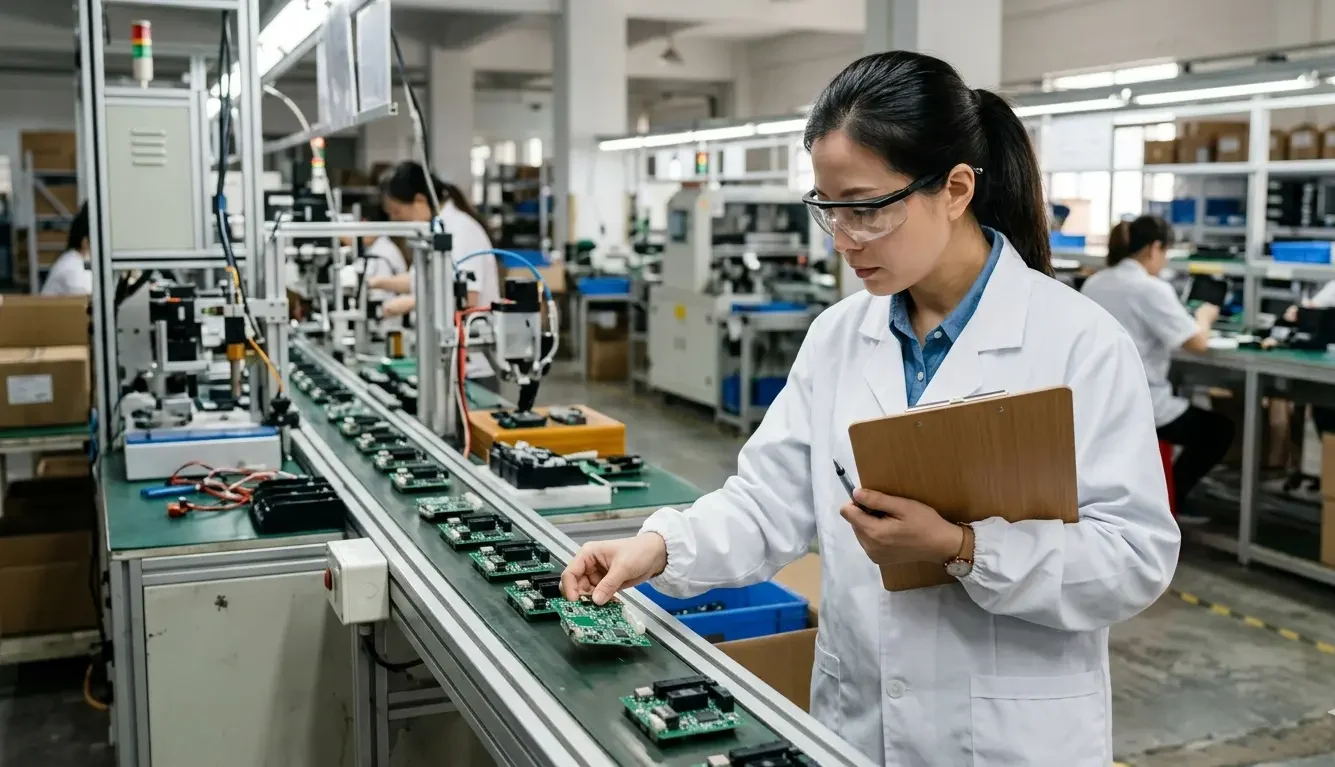
Here is the angle that every dropshipping vs 3PL comparison misses: for brands sourcing from China, there is a third model between traditional dropshipping and a US-based 3PL that captures the advantages of both without the full capital commitment of either. A China-based 3PL like Fulfillmen sits at the origin of your supply chain in Shenzhen, adjacent to your manufacturer, receives your inventory directly from the factory, runs quality control, and ships orders directly to your customers worldwide as they are placed in your store. This eliminates the supplier-direct dropshipping model’s quality and timing problems while avoiding the additional freight leg of shipping bulk inventory to a US warehouse before fulfilling to customers. To understand how this integrates with your sourcing operation, our guide on how to source products from China covers the full model.
The economics of the China 3PL middle path are compelling. You buy inventory in bulk from your manufacturer, which gives you the pricing advantage of the 3PL model 30 to 60% margins versus the 10 to 30% typical of pure dropshipping. Your inventory goes directly from the factory to Fulfillmen’s Shenzhen warehouse, skipping the ocean freight leg to a US warehouse entirely. And orders ship from Shenzhen to your customers in 8 to 15 days via DHL, FedEx, and private line carriers dramatically faster than dropshipping’s 14 to 30 day window, and competitive with standard US-based 3PL delivery times for customers outside North America. For DTC brands with a global customer base, the China 3PL model eliminates the geography disadvantage entirely.
When Dropshipping and China 3PL Work Together: The Hybrid Model
The most sophisticated approach isn’t a binary choice between dropshipping vs 3PL; it’s a staged transition model where both run simultaneously. Stage one: run new products through dropshipping to validate demand before committing to bulk inventory. Use this phase to identify which products have consistent daily sales velocity, which price points your market accepts, and which SKUs generate acceptable return rates. Stage two: once a product hits your validation threshold, consistent daily sales for 30 or more days, return rate under 3%, sustainable customer acquisition cost, move it to a China 3PL model with bulk inventory. Stage three: continue dropshipping new product tests while operating your validated SKUs through the 3PL, so your portfolio is always generating 3PL-level margins on proven products while your dropshipping operation tests the next winners. This hybrid model is how serious ecommerce brands build a sustainable product portfolio without betting their capital on unvalidated ideas.
Why Fulfillmen Is Built for the Dropshipping-to-3PL Transition
No Minimums, No Upfront Commitment
The single biggest barrier brands face when transitioning from dropshipping to a 3PL is the commitment structure of most 3PL providers: monthly minimums, onboarding fees, and long-term contracts that create financial risk before you have data on how the arrangement performs. Fulfillmen operates without any of these barriers. There is no monthly minimum order requirement. There is no onboarding fee. There are no lock-in contracts. You pay for the units you ship and the space you use, which means the financial commitment scales exactly with your sales volume. For brands making their first transition out of dropshipping, that means you can start the 3PL model on a single proven SKU, confirm the economics work for your business, and expand from there without risking monthly minimums on a new model before you’ve validated it. Our China 3PL fulfillment services are built specifically for this transitional stage.
From Factory to Customer — One Partner, One Invoice
Fulfillmen’s Shenzhen warehouse receives goods directly from your Chinese manufacturer, runs incoming inspection against your purchase order specifications using our three-stage QC protocol, stores your inventory, picks and packs orders as they sync from your Shopify or WooCommerce store in real time, and ships worldwide via DHL, FedEx, UPS, and our private line carrier network. One partner, one invoice, and one communication channel for your entire post-manufacturing logistics operation. For brands transitioning from dropshipping where the supplier managed all of this with no visibility and no accountability the shift to a documented, inspected, tracked fulfillment operation is transformative for customer experience scores and review ratings within the first 30 days.
Talk to Us Before You Commit to Inventory
If you are on the edge of the dropshipping vs 3PL decision and aren’t sure whether your order volume justifies the switch, Fulfillmen’s operations team will model the exact cost comparison for your current products. Share your monthly order volume, your supplier’s product cost, your retail price, and your main shipping destinations, and we’ll give you a clear side-by-side of your current dropshipping economics versus a Fulfillmen 3PL model including shipping times by destination, cost per order, and the break-even point where 3PL becomes the more profitable choice. Get in touch via our contact page. No commitment required.
Frequently Asked Questions: How to Source From China
How do I start sourcing from China as a small ecommerce brand?
Start by identifying your product category and target retail price, then reverse engineer your maximum landed cost before you search any supplier. Use Alibaba for initial supplier discovery, filtering by Trade Assurance and Verified Supplier status. Request samples from at least three to five suppliers before committing to any production order. For brands shipping fewer than 500 units per month, a China-based 3PL like Fulfillmen can handle sourcing, quality control, and fulfillment in one step removing the need to manage suppliers, inspectors, and freight forwarders separately.
What is the difference between Alibaba, 1688, and a sourcing agent?
Alibaba is an English language B2B marketplace connecting international buyers to Chinese manufacturers, with Trade Assurance payment protection. 1688 is Alibaba’s domestic Chinese platform offering 30 to 50% lower prices but requiring Chinese-language navigation. A sourcing agent is a person or company in China who negotiates with manufacturers, handles quality inspection, and coordinates shipping, typically charging 5 to 10% of order value. For ecommerce brands sourcing consistently, a China-based 3PL that includes sourcing services combines all three functions under one accountable partner.
How do I verify a Chinese supplier is legitimate before sending payment?
Verify through four steps: confirm Trade Assurance and Verified Supplier status on Alibaba, request their business license (Yingye Zhizhao) and cross-check the company name against their Alibaba profile, order samples before any production run, and never pay via Western Union or personal bank transfers. Use Alibaba Trade Assurance, PayPal Goods and Services, or a letter of credit for large orders. Legitimate manufacturers without exception accept standard B2B payment methods.
What is quality control and why does it matter when sourcing from China?
Quality control is the process of inspecting products before they leave the factory or fulfillment center to catch defects before they reach customers. Shopify’s fulfillment guide puts failure rates at 15 to 20% of incoming shipments without professional QC. Three checkpoints matter most: pre-production on raw materials, inline during manufacturing, and pre-shipment final inspection. A China-based 3PL with in-house QC eliminates the cost of a separate inspection agency and creates documented evidence at every stage.
How long does it take to ship products from China to the USA?
Express air freight via DHL, FedEx, or UPS takes 5 to 10 business days at $4 to $8 per kg. Economy air takes 12 to 20 days at $1 to $3 per kg. Sea freight takes 25 to 35 days at $0.10 to $0.50 per kg and is only viable for bulk inventory. For ecommerce sellers using a China 3PL, individual orders typically ship in 8 to 15 days via private line carriers at negotiated volume rates faster than economy air and significantly cheaper than express courier on a per-unit basis.
Do I need a sourcing agent or can I use a 3PL for sourcing from China?
A standalone sourcing agent makes sense for large, irregular bulk orders where dedicated factory negotiation justifies the 5 to 10% commission. A China-based 3PL that includes sourcing services like Fulfillmen is more practical for growing ecommerce brands because it combines supplier sourcing, quality control, storage, fulfillment, and shipping under one operational partner. This eliminates the handoff between separate service providers and means one accountable party manages your product from factory to customer doorstep.