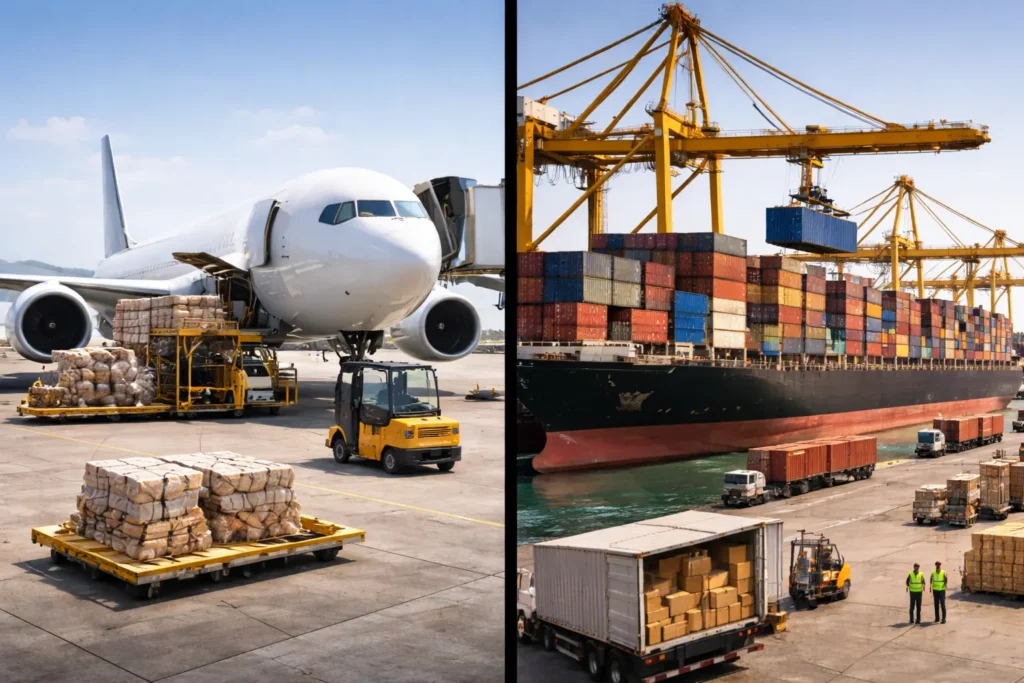
Pick the wrong freight method and it’ll cost you either in cash or in stockouts. The air freight vs sea freight debate trips up more eCommerce sellers than almost any other logistics decision. Sea freight looks cheaper on paper. Air freight looks like the obvious answer when you’re in a rush. But neither of those instincts is the full picture.
The real answer depends on your product, your margins, your order volume, and how much lead time you can stomach. Here’s the full breakdown real 2026 rates, actual transit times, hidden costs, and a simple decision framework that tells you exactly which method to use and when.

What's the Actual Difference Between Air Freight and Sea Freight?
Air Freight Speed at a Price
Air freight moves your goods by cargo aircraft. It’s fast, predictable, and secure. Shipments from China to the US land in 5–10 days door to door depending on the route and carrier. That’s it. No sitting in ports, no vessel schedules to work around, no weekvlong customs queues.
The trade-off? It costs way more. Current 2026 air freight rates from China to the US sit at roughly $4.50–$8.50 per kg for standard air cargo. Express services through DHL, FedEx, or UPS push that to $6–$12 per kg. For heavy or bulky shipments, that premium adds up fast.
Sea Freight Cost at a Timeline
Sea freight moves your goods on cargo ships in containers. It’s the backbone of global trade maritime transport carries roughly 80–90% of all global merchandise by volume. It’s dramatically cheaper than air, but significantly slower.
Current 2026 sea freight rates from China to the US West Coast run $1,900–$3,200 for a 40ft FCL container and $110–$150 per CBM for LCL shipments. On a per kg basis, sea freight is typically 5–16 times cheaper than air freight. The catch is the timeline 25–45 days door to door, and that’s when things run smoothly. Port congestion, customs holds, and vessel bunching can add another 5–15 days on top of that.
Ocean Freight vs Air Freight Cost Real Numbers Side by Side
Stop comparing just the freight invoice. The real cost comparison includes everything that changes between the two methods.
Air Freight | Sea Freight | |
Cost per kg (2026) | $4.50–$8.50 | $0.18–$0.32 (est. equiv.) |
Transit time (China–US) | 5–10 days | 25–45 days |
Minimum shipment | ~150 kg (economical) | 1 CBM (LCL) |
Customs broker needed | Yes | Yes |
Risk of delay | Low | Medium–High |
Cargo security | Very high | High (containerised) |
Carbon footprint | 40–50x higher | Lower |
Best for | Urgent, high-value, lightweight | Bulk, heavy, non-urgent |
The Hidden Costs That Tip the Balance
Here’s what most air freight vs sea freight comparisons miss entirely: the full picture includes inventory carrying costs, storage fees, and stockout risk not just the freight invoice.
With sea freight, your goods are in transit for 30–45 days. That’s 30–45 days of capital tied up in goods that aren’t selling yet. If you’re carrying $200,000 of inventory on the water, you’re effectively paying the cost of that capital sitting idle. Add domestic warehousing on arrival, and the “cheap” option gets more expensive than it first appeared.
With air freight, you’re shipping smaller, more frequent batches. Less inventory tied up. Less warehousing needed. Faster revenue cycle. For high margin, fast moving products, that cash flow advantage can more than offset the higher per-kg rate.
Air Freight Advantages When It's the Right Call
You're Running Low on Stock Fast
Nothing kills an eCommerce business faster than a stockout during peak demand. You lose the sale. You lose your ad spend efficiency. You lose your marketplace ranking and recovering that ranking can take weeks. A stockout during Black Friday, Prime Day, or any viral moment is a nightmare scenario. Air freight from China to US in 5–10 days is the only way to plug that gap before it costs you more than the freight premium does.
You're Launching a New Product
Launching with sea freight means waiting 6–8 weeks from production sign-off to having goods in a US warehouse. That’s 6–8 weeks of delay before you can test, iterate, and scale. Air freight collapses that timeline to under two weeks. For new product testing, air freight pays for itself in speed to market alone.
Your Products Are High Value and Lightweight
Think electronics, premium cosmetics, medical devices, jewellery. When freight cost is less than 5–10% of your product’s value, air freight makes complete sense. The higher per kg rate is a rounding error next to your per unit margin. Additionally, air cargo has less handling than sea freight, which means lower damage risk on fragile or high ticket items.
You're Shipping Under 150 kg
Sound familiar? Air freight actually gets competitive for very small shipments. Below roughly 150 kg, the LCL sea freight process consolidation at origin, deconsolidation at destination, extra handling fees on both ends can close the cost gap significantly. Don’t assume sea freight wins on cost for tiny shipments without running the actual numbers.
Sea Freight Transit Time When Slower Is Smarter
Your Products Move Predictably
If you know roughly how many units you sell per week and your demand doesn’t swing wildly, sea freight is a no brainer for bulk restocking. Plan your orders 6–8 weeks out, use sea freight FCL or LCL, and your per-unit cost drops dramatically. The slower sea freight transit time becomes part of your supply chain rhythm rather than a problem.
You're Shipping Heavy or Bulky Goods
Furniture, home goods, large electronics, or industrial equipment heavy or high volume products make air freight completely uneconomical. Shipping 10,000 kg of furniture by air costs roughly $48,500 and takes 5 days. By sea, that same shipment costs around $3,000 and takes 35 days. You’re not paying 16x more for 30 days of saved transit time. Sea freight wins here, full stop.
You're Watching Margins Closely
Sea freight keeps per unit logistics costs down, which protects your gross margin on lower-priced products. If your product retails at $25 and your margin is $7, adding $3–4 per unit in air freight costs wipes out nearly half your profit. For budget conscious sellers shipping at volume, sea freight isn’t just an option it’s a necessity.
You're Shipping Regularly at Scale
Once your business is moving consistent volumes say, 2–3 full containers per quarter FCL sea freight becomes your best friend. Fixed flat rate pricing per container. No consolidation delays. No sharing space with other importers. The ocean freight vs air freight cost gap at FCL volume is massive, and it compounds over time.
The Hybrid Model Best of Both Worlds
What the Smartest eCommerce Brands Do in 2026
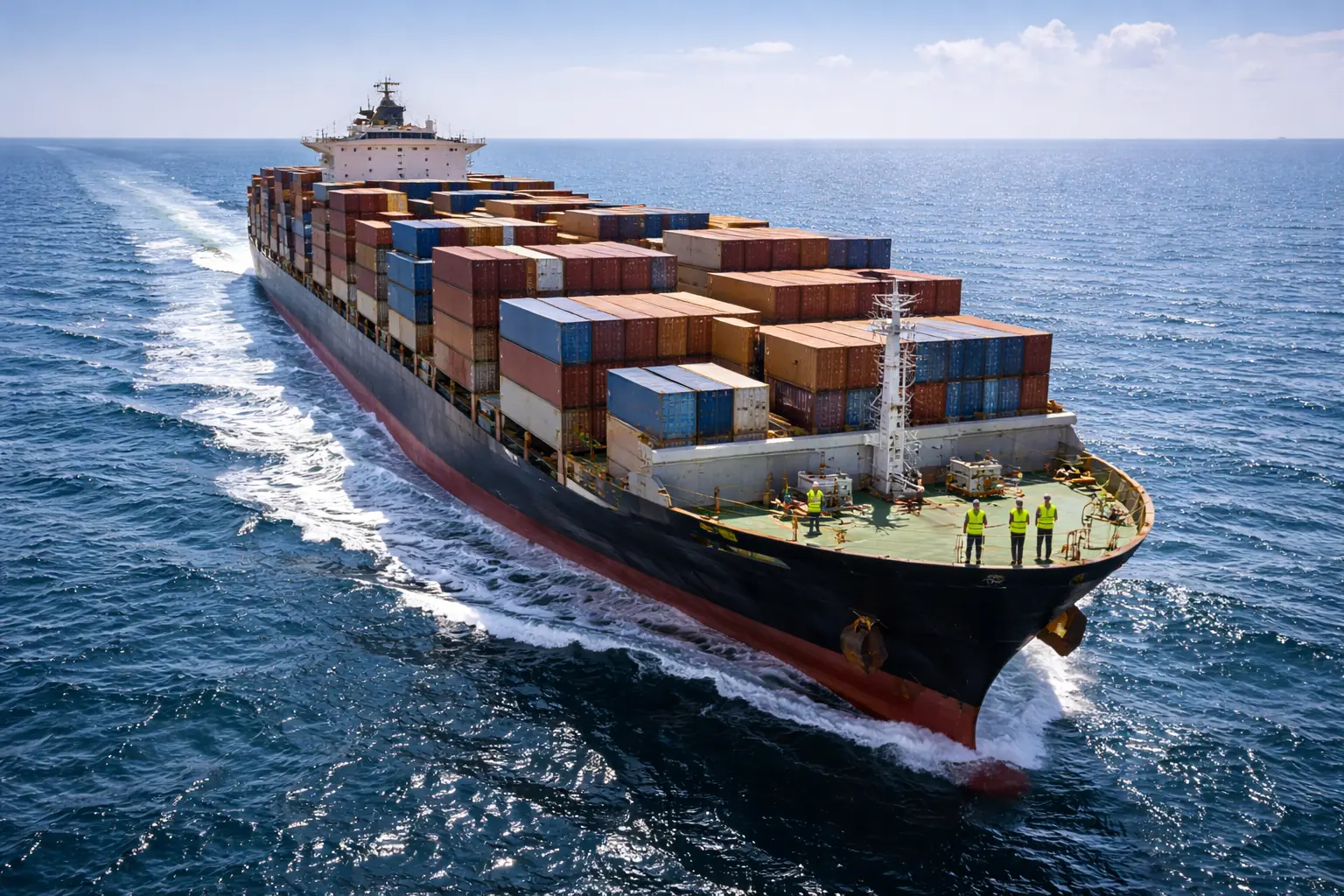
Here’s the thing most guides don’t tell you: the answer isn’t always air or sea. It’s both strategically. The 2026 industry trend is a “Core and Surge” hybrid model, and it works like this:
- Sea freight for core inventory — products you know sell consistently throughout the year. Ship by FCL or LCL on a regular schedule. Keep per-unit costs low.
- Air freight for surge demand — bestsellers that spike unexpectedly, new launches, or anything that needs to hit the shelf before a peak sales window closes.
Additionally, during Q3 and Q4, ocean freight reliability drops as port congestion builds ahead of the US holiday season. High performing brands switch time sensitive SKUs to air during this window specifically to guarantee availability when it matters most.
According to global logistics management best practices from Inbound Logistics, linking transportation planning to real demand signals rather than relying on a single freight mode is one of the highest ROI moves in supply chain management. The hybrid model does exactly that.
How to Decide Which Products Go by Air vs Sea
Run this quick check for each SKU:
- Does this product sell more than 15 units/day? → Consider air for restocks
- Is my product margin above 40%? → Air freight premium is absorbable
- Can I forecast demand 6–8 weeks out? → Sea freight works safely
- Is this a new product launch? → Air freight to test fast
- Is this heavy or bulky (over 200 kg, low density)? → Sea freight every time
Which Is the Best Shipping Method for eCommerce?
The Honest Answer
Neither method is universally better. They solve different problems. Air freight is the best shipping method for ecommerce when speed, product value, or stockout risk justify the premium. Sea freight is the best shipping method for ecommerce when volume, weight, and predictable demand make cost per unit the priority.
Most growing eCommerce businesses end up using both sea freight as the baseline, air freight as the safety valve. Understanding supply chain management terms like landed cost, chargeable weight, and FCL vs LCL helps you make these calls confidently rather than guessing every time.
Watch Out for the Dimensional Weight Trap
One last thing worth flagging. Air freight carriers charge on chargeable weight the higher of actual weight or dimensional weight. The formula: length × width × height (cm) ÷ 6,000. If you’re shipping light but bulky goods, your bill can double or triple versus what actual weight suggests. Always calculate this before booking air freight it’s one of the most common costly surprises sellers run into.
How Fulfillmen Solves the Air vs Sea Dilemma for eCommerce Sellers
Choosing between air freight vs sea freight sounds straightforward until you’re actually doing it juggling lead times, carrier negotiations, seasonal fluctuations, and customs documentation all at once. That’s where most sellers get it wrong. Not because they picked the wrong mode, but because they’re managing it all alone without the infrastructure to do it properly.
Both Air and Sea Under One Roof
Fulfillmen handles both air freight and sea freight from China to the US through its logistics services, meaning you don’t need separate freight forwarders for different shipping modes. One partner. One conversation. Whether you need a fast air restock or a cost efficient FCL sea shipment, it all runs through the same system with real time tracking at every stage.
Multi Warehouse Network That Removes the Transit Time Problem
Here’s something the air vs sea debate often ignores: if your inventory is already sitting in a US warehouse, neither transit time matters. Fulfillmen operates warehouses in China, Hong Kong, India, and the USA. Inventory stored at the US warehouse ships to your customers in days no freight decision required for individual orders. You use sea freight for bulk restocking (cheap), and the US warehouse handles fast last mile delivery (fast). That’s the hybrid model built into the infrastructure itself.
90 Days Free Storage Plan Without Panic
The reason most sellers resort to expensive air freight is panic they’re nearly out of stock and sea freight won’t arrive in time. Fulfillmen’s 90 days of free storage eliminates that panic cycle. Stock up by sea freight when rates and timing suit you. Hold inventory in Fulfillmen’s warehouse at zero storage cost for up to three months. Ship to customers from the US warehouse in days. No last minute air freight premiums because you planned ahead. Check out Fulfillmen’s fulfillment services and see how this works in practice. Ready to stop choosing between fast and affordable? Get a free quote today.
FAQs: Air Freight vs Sea Freight
Is air freight always faster than sea freight?
Yeah, always no contest there. Air freight from China to the US takes 5–10 days door to door. Sea freight takes 25–45 days, and that’s when things go smoothly. Port congestion, customs holds, and vessel scheduling can push sea freight even longer. If speed matters, air freight wins every time. The question is whether that speed is worth the cost premium for your specific product and situation.
How much cheaper is sea freight than air freight?
On a per kg basis, sea freight is roughly 5–16 times cheaper than air freight. A 1,000 kg shipment by air from China to the US costs somewhere in the range of $4,500–$8,500. By sea (LCL), that same shipment might run $600–$900 all in. FCL gets even cheaper per unit at scale. That said, don’t forget to factor in storage, carrying costs, and stockout risk the real cost gap between the two modes is usually smaller than the raw freight rate suggests.
When should I use air freight instead of sea freight?
Use air freight when you’re running low on fast moving stock, launching a new product, dealing with a demand spike, or shipping high value lightweight goods where the per kg premium is a small percentage of product value. Also worth using air during Q4 when sea freight gets congested and unreliable. Basically when timing matters more than the freight invoice, go air.
What are the biggest disadvantages of air freight?
Cost is the big one it’s 5–16x more expensive than sea freight per kg. Then there’s the dimensional weight trap: bulky but light items get charged on volume, not actual weight, which can double or triple your bill unexpectedly. Air freight also has stricter cargo restrictions lithium batteries, aerosols, and certain hazardous materials face tighter limits by air than by sea. And for very large, heavy shipments, air freight simply doesn’t make economic sense regardless of urgency.
Can I use air freight and sea freight together?
Absolutely and honestly, that’s what the smartest eCommerce brands do. Use sea freight as your baseline for core, predictable inventory to keep costs low. Use air freight as a surge tool for bestsellers, new launches, and peak season restocks. This hybrid “Core and Surge” model gives you the best of both cheap bulk shipping for stable inventory, fast air restocking when demand spikes or stock runs low.
Which is the best shipping method for ecommerce sellers?
There’s no single best answer it genuinely depends on your product. Air freight is the best shipping method for ecommerce when you’re selling high margin, lightweight, fast moving products where speed protects revenue. Sea freight is the best shipping method for ecommerce when you’re shipping heavy, bulky, or high volume goods with predictable demand cycles. Most scaling brands use both strategically rather than picking one and sticking with it.